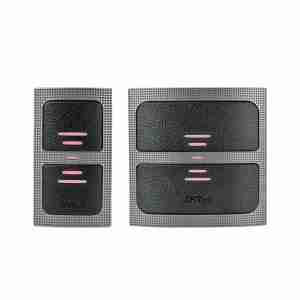
Radio-Frequency Identification or RFID has significantly transformed the way we interact with objects in our daily lives, such as access cards, credit cards, and transportation cards. By offering a contactless way of making payments, accessing doors and storing crucial information, they offer a great deal of convenience in various settings, such as offices, hotels, hospitals, and public transportation systems.
An RFID card, or Radio-Frequency Identification card, is a device that utilises radio waves to communicate with a reader. These cards often come in various forms such as access cards, credit cards, transportation cards, and even key fobs. Typically, RFID cards are embedded with a microchip and an antenna, which enables them to interact with RFID readers. Every RFID card has a unique identifier that can be read by an RFID reader. This information usually comprises an individual’s identification details, access permissions, payment information, or other important data depending on the purpose of the card. Contrary to traditional barcode or magnetic stripe cards, RFID cards don’t require physical contact with the reader. Due to this contactless feature, RFID cards are more robust and user-friendly, and do not suffer from wear and tear generally associated with physical contact cards.
RFID cards utilise electromagnetic fields for their functionality. When an RFID card is positioned near a reader, the card’s microchip gets activated by the reader’s electromagnetic field. The data stored in the microchip of the RFID card is transmitted via radio waves back to the reader, which is then processed and interpreted by the system.
Empower your organisation with highly advanced, secure and reliable RFID card readers from ZKTeco! To learn more about ZKTeco’s cutting-edge RFID readers, get in touch with ScreenCheck, your trusted RFID reader distributor in India.
FAQs
1. Is ZKTeco’s KR500 series compatible with EM-compatible cards and readers?
KR500 Series is a versatile, user-friendly option for current systems that require EM card technology. It is compatible with a wide array of EM-compatible cards and readers.
2. What is the power consumption of KR500 series?
It is powered between 6 – 16V DC with a low power consumption of Max 70mA.
3. What are the various types of RFID Card readers?
RFID card readers are categorised based on the frequency they operate on. This includes Low-Frequency (LF) RFID Readers, High-Frequency (HF) RFID Readers, Ultra-High-Frequency (UHF) RFID Readers, Active and Passive RFID Readers
4. What are the common applications of RFID card readers?
RFID card readers are commonly used in access control systems, Inventory and asset tracking, Healthcare, Supply chain management, Transportation and ticketing systems, Contactless payments, Attendance and Time Management.